


EGCG vs Green Tea Polyphenols: Which Grade Should Cosmetic Formulators Choose?
EGCG is one component of green tea polyphenols, not a separate alternative to the entire polyphenol family. For cosmetic development, compare a high-purity EGCG grade with a mixed green tea extract using quantified composition, assay method, solution behavior and batch documentation.
A “98% EGCG” claim and a “90% total polyphenols” claim do not describe the same analytical measurement. Neither number alone guarantees a colorless serum, complete dissolution, low caffeine or shelf stability. Select the grade against the requirements of the actual formula, then confirm performance experimentally.
Written by Blueeyes Bio Technical Content Team
Publisher: Blue Eyes Biotech Co., Ltd.
Technical scope: cosmetic raw-material selection, comparative screening and supplier qualification.
1. First, Compare Like with Like: EGCG, Catechins and Total Polyphenols
Green tea extracts can contain several catechins, including epigallocatechin gallate (EGCG), epicatechin gallate (ECG), epigallocatechin (EGC) and epicatechin (EC). Their relative amounts depend on the raw material and processing. Other constituents, moisture and any added carriers also affect the supplied preparation.
EGCG has CAS number 989-51-5 and a molecular weight of approximately 458.37 g/mol. These identify the molecule; they do not establish the composition or quality of a commercial powder.
Total-polyphenol colorimetric testing and compound-specific HPLC testing answer different questions. Published comparisons of green tea extract assays show why the analytical method matters when interpreting a total-polyphenol result.[1]
2. High-Purity EGCG vs Standardized Green Tea Polyphenols
The following comparison describes qualification questions, not universal specifications. The percentages shown are purchasing descriptions that must be checked against the supplier’s actual specification and batch results.
| Selection Point | High-Purity EGCG Grade | Standardized Mixed Polyphenol Extract |
|---|---|---|
| Typical purchasing description | For example, a grade specified as 98% EGCG; confirm the quantitative method and reporting basis. | For example, 50%, 70% or 90% total polyphenols; identify the assay method and separate catechin profile. |
| Composition | EGCG is the principal specified constituent. Residual constituents still require characterization. | A mixture whose EGCG, other catechins and non-catechin constituents require separate documentation. |
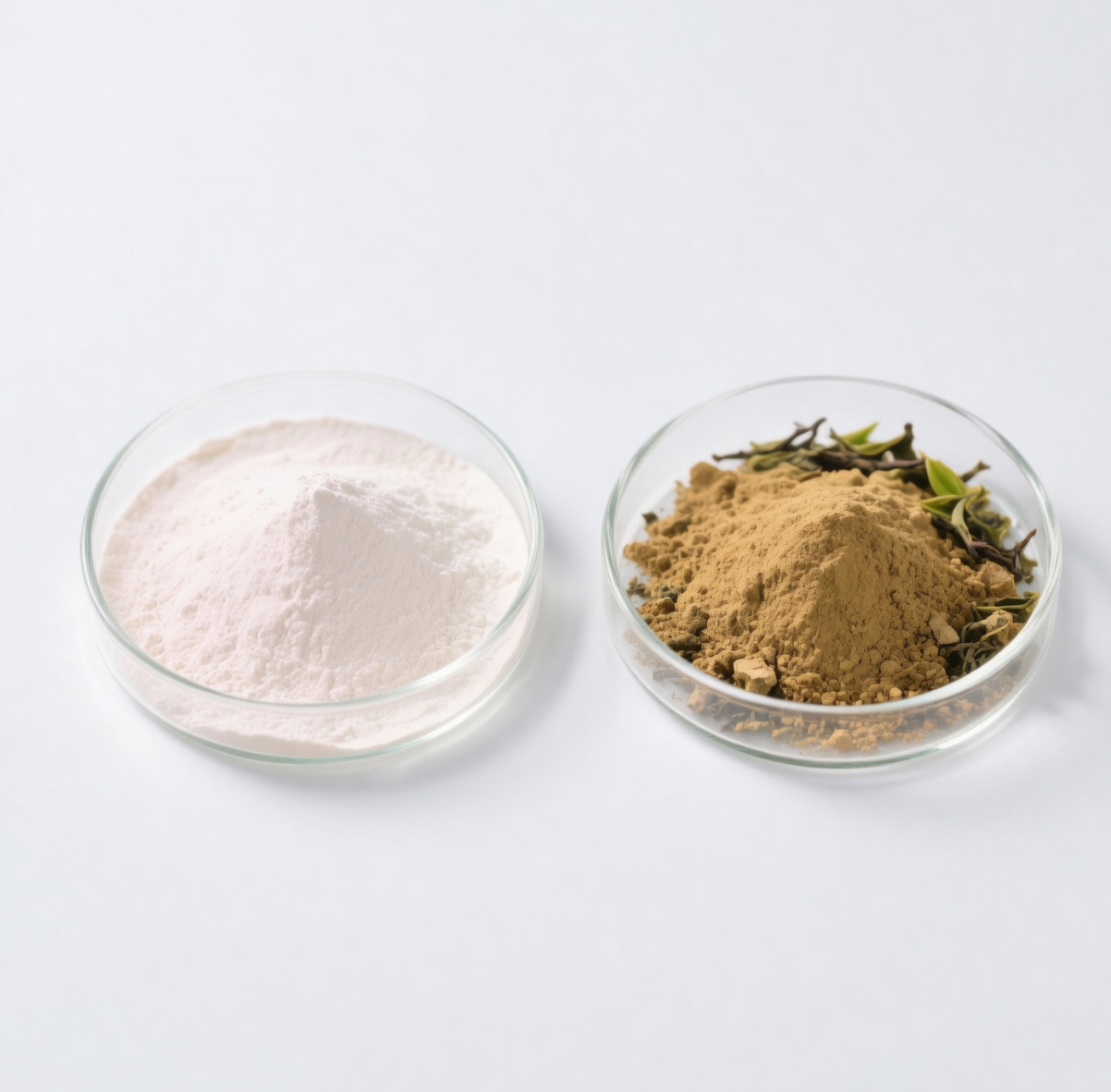
| Powder appearance | Check the actual lot against an agreed appearance specification. A pale powder is not proof of purity. | Color can vary. Brown-yellow appearance alone does not establish assay, contamination or suitability. |
| Caffeine | Require a separate result if low caffeine is important. Do not infer a limit from EGCG purity alone. | Check the selected grade. Mixed extracts may have different caffeine specifications, including decaffeinated options. |
| Clear aqueous formulas | A candidate when controlled EGCG loading is required; test dissolution, baseline color and storage stability. | A candidate if the preparation meets the formula’s color and clarity limits; do not reject it solely on total-polyphenol percentage. |
| Emulsions and rinse-off products | May be evaluated where a defined EGCG content is part of the development target. | May be evaluated where a mixed extract fits the sensory, composition and cost targets. |
| Cost comparison | Compare cost at the required verified EGCG loading, including testing and processing implications. | Compare against the same formulation objective, not just price per kilogram or a non-equivalent assay percentage. |
3. Solubility, Color and Clarity Are Different Measurements
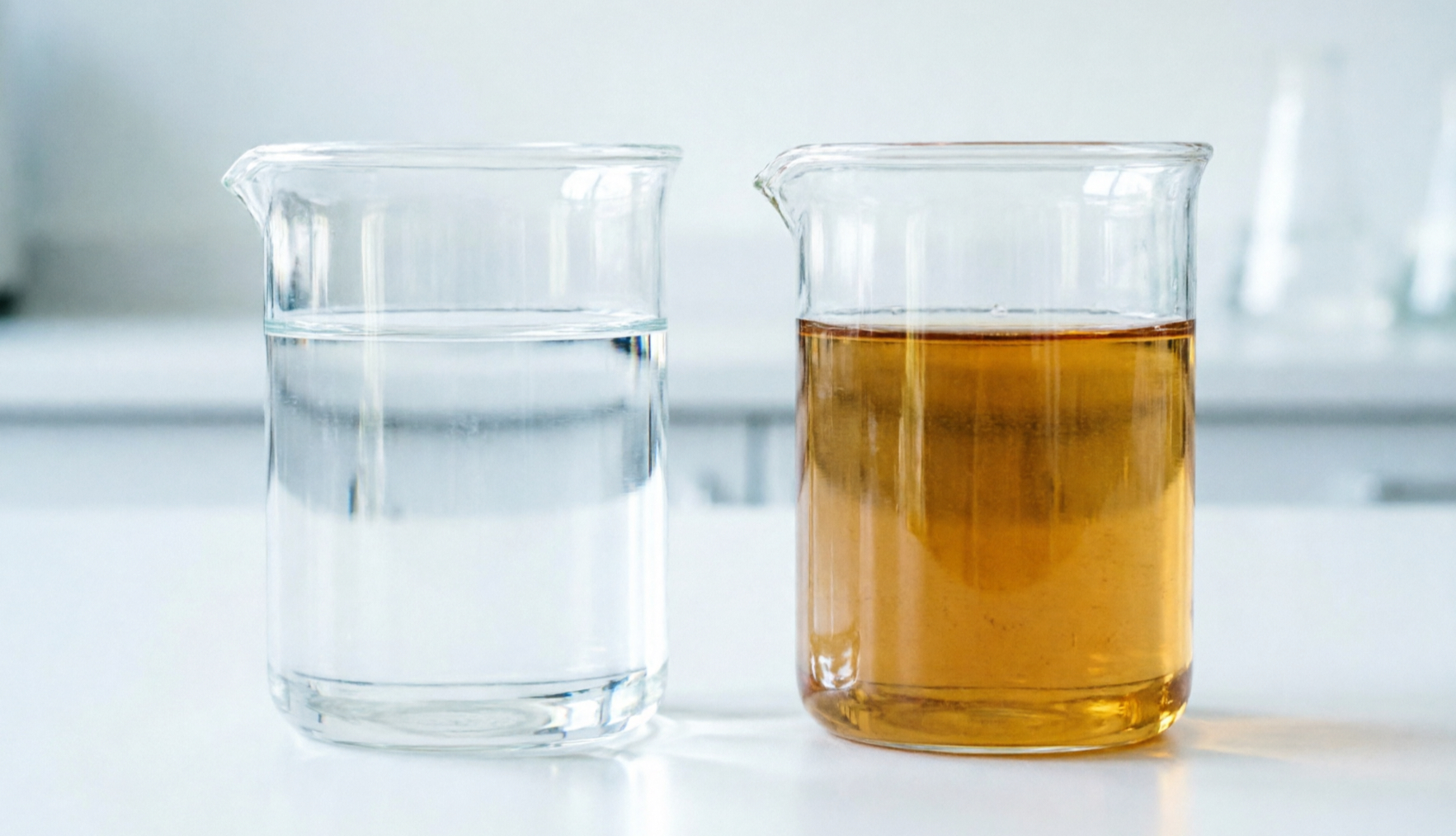
A colored solution can be fully dissolved. A pale preparation can still contain undissolved material. A sample that looks clear immediately after mixing can develop sediment or discoloration during storage.
For this reason, a purchasing statement such as “water soluble” is incomplete unless it identifies the concentration, water or vehicle composition, temperature, pH, mixing procedure and observation period.
| Endpoint | Record During Screening | Interpretation Limit |
|---|---|---|
| Dissolution | Added mass, vehicle mass, mixing conditions, temperature and undissolved residue. | Visual disappearance alone is not an equilibrium-solubility measurement. |
| Color | Standardized photographs or instrumental color data with a suitable blank. | Color does not independently quantify EGCG or prove degradation. |
| Clarity and haze | Turbidity or another defined optical method, plus visible particles and sediment. | Haze may involve insoluble constituents or formula interactions; investigate the cause. |
| Storage behavior | Changes in appearance, pH and quantified actives under documented conditions. | An acceptable initial appearance is not a shelf-life result. |
4. Design a Fair Comparison Before Choosing a Clear-Serum Grade
Use two complementary comparisons. An equal ingredient-loading comparison shows what happens when the same mass of each commercial preparation is added. An equal verified EGCG-loading comparison addresses a different question: how the preparations behave when they deliver the same measured amount of EGCG.
Do not calculate an equal-EGCG comparison from a total-polyphenol result. Obtain an appropriate quantitative EGCG result first, and reconcile dry-basis results with moisture before calculating as-supplied addition levels.
Calculation using an as-supplied assay:
EGCG in the formula (%) = ingredient addition (%) × EGCG assay (%) ÷ 100
Example for calculation only: 0.50% of an ingredient containing 98.0% EGCG as supplied contributes 0.49% EGCG. This is not a recommended cosmetic use level or a verified Blueeyes Bio batch result.
- Include a vehicle blank and document every sample’s identity and lot.
- Use the same water quality, vessel, mixing procedure and observation schedule.
- Record initial pH and any adjustment; do not conceal different conditions behind one comparison photograph.
- Measure initial color, clarity and active content before storage.
- Repeat the comparison in the actual serum or emulsion and intended packaging.
- Set acceptance criteria before reviewing results, including limits for appearance and active retention.
If a 1% w/w ingredient-loading test is used, describe it as a screening condition, not a solubility guarantee or recommended application level. A successful water-only screen does not establish compatibility with preservatives, electrolytes, thickeners or other actives.
5. Analytical Qualification: Read the Results, Not Just the Purity Claim
Before approving an EGCG or green tea polyphenol grade, review the analytical results together with their methods and reporting basis. A percentage without a clearly defined analyte and calculation is not sufficient for a meaningful comparison.
- Sample traceability: confirm the product designation, batch number and test or report date.
- Analyte identification: distinguish EGCG from total catechins and total polyphenols.
- Quantitation: check calibration, units and calculation basis; calibrated content and peak-area normalization are not interchangeable.
- Reporting basis: establish whether the result is on a dry or as-supplied basis, with moisture information where needed.
- Caffeine control: request a separate quantitative result and reporting limit when caffeine is a purchasing criterion.
- Method suitability: confirm that the method is appropriate for the selected preparation and intended analytical purpose.
If caffeine below 0.5% is a purchasing requirement, state it explicitly in the agreed specification and request the corresponding batch result. “Decaffeinated” should not be treated as synonymous with caffeine-free.
Review relevant residual-solvent, trace-element and microbiological results as separate qualification items. A manufacturing solvent declaration does not replace analytical testing where testing is required by the agreed risk assessment.
Regulatory boundary: a supplier’s raw-material specification is not a finished-cosmetic approval. California Proposition 65 warning obligations depend on relevant exposure rather than raw-material concentration alone. [4]
In the European Union, Article 17 of Regulation (EC) No 1223/2009 addresses technically unavoidable traces of prohibited substances under good manufacturing practice, subject to finished-product safety. Lead and arsenic limits alone do not establish full compliance. [3]
6. Sample and COA Request Guide: Plan Your Quality Review
A useful sample request should connect the development objective, the proposed ingredient grade and the documents needed for approval. Ask about a 50 g R&D sample and the batch-linked analytical information available for the proposed material.
Step 1: Describe Your Formulation Requirements
Identify the product format, such as a clear aqueous serum, emulsion or rinse-off product. Include your target EGCG content, planned ingredient addition level, intended pH range and acceptable color or clarity limits. Specify any caffeine requirement rather than assuming it follows from the EGCG percentage.
Step 2: Request the Specification and Batch COA
Request the agreed grade specification and a COA corresponding to the sample or proposed supply batch. Check the product name, lot number, test methods, acceptance criteria, reported results and reporting basis. If the document is a representative COA rather than the COA for the proposed batch, ask for that distinction to be made explicit.
Step 3: Define the HPLC Information You Need
State whether you need a quantitative EGCG result, a catechin profile, a caffeine result or supporting method information. Ask which batch HPLC records are available and whether additional testing would be required. Do not assume that every COA includes the same analytical scope or supporting records.
Step 4: Confirm the Sample and Evaluation Conditions
Confirm the sample grade, lot identification, available quantity, packaging, shipping arrangements and any charges before dispatch. Record the received sample details and evaluate it using a documented protocol. If the later commercial batch differs from the sample batch, review its own COA and apply the agreed incoming-quality checks.
For an efficient enquiry, send your company name, destination country, application, requested grade, caffeine limit if applicable and the analytical documents required by your QA team.
Request Batch HPLC Analysis & 50g Sample via WhatsApp
Sample availability, quantity, charges, shipping and analytical documentation are subject to confirmation for the selected grade and batch.
7. Select for the Formula, Not for the Highest Percentage on the Label
For a transparent serum, prioritize reproducible solution appearance, a suitable analytical profile and acceptable active retention in the final package. For an emulsion or cleanser, a broader extract may fit the product concept, but opacity does not remove the need for chemical stability or safety evaluation.
High purity should not be translated automatically into greater topical efficacy, lower irritation or better formulation stability. Those conclusions require evidence relevant to the actual ingredient, dose and finished product.
Start supplier discussions with the required composition and application targets forcosmetic grade green tea extract. Once candidate grades have been selected, use our guide tohow to prevent EGCG browning in serumsto plan oxidation-related screening.
If the project also includes vitamin C or niacinamide, reviewgreen tea extract with vitamin C and niacinamide compatibilitybefore selecting the final pH and stability protocol. Raw-material selection and multi-active compatibility are connected tasks, but neither replaces testing of the complete formula.
8. Buyer Checklist: Documents to Request Before Approval
- Exact product designation, botanical identity and applicable ingredient declaration.
- Complete supplied composition, including any carriers or processing additives requiring disclosure.
- Separate definitions and methods for EGCG, total catechins and total polyphenols.
- Agreed specification and a traceable COA for the batch under consideration.
- Caffeine result and reporting limit when caffeine control is required.
- Moisture, appearance, storage conditions and supported shelf-life information.
- Relevant contaminant results and residual-solvent documentation.
- Available batch HPLC results and clarification of any additional testing needed.
- Sample identity matched to the proposed commercial grade, with change-control expectations agreed before purchase.
Discuss Your EGCG or Green Tea Extract Specification
Share your application, target composition and color or clarity requirements with Blueeyes Bio. Request the proposed grade specification, batch COA, available HPLC analysis and confirmation of a 50 g R&D sample.
The appropriate grade and supporting documents should be confirmed before laboratory evaluation or commercial approval.
Request Batch HPLC Analysis & 50g Sample via WhatsApp
Email: [email protected]
Sample terms, shipping, stock status and document availability require confirmation.
Frequently Asked Questions
Is 98% EGCG the same as 98% green tea polyphenols?
No. EGCG is one specific catechin, while total polyphenols is a broader analytical category. Compare the named analyte, test method, calculation and reporting basis before treating two percentages as equivalent.
Does high-purity EGCG guarantee a clear, colorless serum?
No. Solution appearance depends on the actual grade, concentration, vehicle, pH, processing and storage. Evaluate dissolution, color, haze and active retention separately in the complete formula and intended package.
Does a 98% EGCG specification prove caffeine below 0.5%?
No. Require a separate caffeine specification and a suitable batch result with its reporting limit. EGCG purity alone does not establish caffeine content, and decaffeinated does not necessarily mean caffeine-free.
References and Evidence Limits
[1]“Comparison of colorimetric methods for the analysis of total polyphenols in green tea extracts.” Bioscience, Biotechnology, and Biochemistry, 2024. Relevant to assay interpretation; it does not validate any Blueeyes Bio batch.
[2]“Great green tea ingredient? A narrative literature review on epigallocatechin gallate and its biophysical properties for topical use in dermatology.” Phytotherapy Research, 2020. Background on topical EGCG development, not a head-to-head performance guarantee for commercial grades.
[3]Regulation (EC) No 1223/2009 on cosmetic products, including Articles 3 and 17 and Annex I. Consult the applicable version and amendments for the intended market.
[4]California Department of Justice, Proposition 65 Frequently Asked Questions. Explains the distinction between product concentration and exposure-based warning requirements.
Evidence limitation: this article does not report a controlled comparison of Blueeyes Bio samples, verify a current batch specification or establish a finished-product shelf life. Any sample photographs added to this page must be genuine, accurately described and traceable to their stated samples. Analytical records should be reviewed against the actual material under consideration. This guide is not a finished cosmetic formula or a regulatory approval.
Technical Summary
Blueeyes Bio’s selection framework distinguishes compound-specific EGCG content from total-polyphenol claims. Qualify the assay, reporting basis, caffeine result and batch documents, then compare dissolution, color, clarity and active retention under defined conditions. Request samples and analytical records for the proposed grade before approval. Neither a high purity percentage nor an attractive comparison image establishes finished-formula stability or regulatory compliance.


